

Heat, Cold, Conditions At Work Are Both Equally Foreseeable Occupational Risks For Standard And Shift Workers
Coordination between unions on gathering evidence for the proposed heat-risk frameworks appears to be ongoing, with some elements — including a proposed worker survey and a representative-led process for independently checking workplace temperature records — still unresolved.
There is no doubting the fact that employers have a positive legal duty to identify and understand reasonably foreseeable risks arising from their operations — including extreme-temperature risks — and that this duty extends beyond what an employer can show it actually knew to what it ought reasonably to have known had proper risk assessments been carried out.
 This is the premise upon which the campaigns to insist on minimum and maximum temperatures at workplaces, be they indoors or outdoors together with appropriate mitigations including stopping of the work; are enshrined within workplace health and safety legislation.
Further, all working patterns including that of shift-working must be included, with no abdication of responsibility by the employer for the length and method of exposure to temperatures that are a danger to human health.
With Trade Unions such as the CWU and Unite campaigning on the urgent need for the UK to adopt Workplace Health and Safety Standards that recognise climate change and the realities that already exist; which make Hot or Cold workplaces a danger to workers short-term and long-term health, there is a serious need for evidential data and the development of frame works that can be used in formulating agreements with employers and for law makers and the HSE to act in relation to workplace temperature health & safety standards.
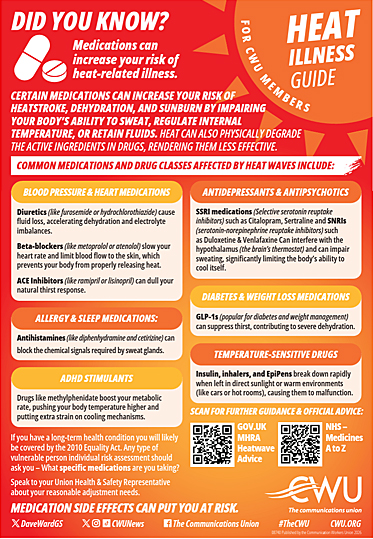
Jamie McGovern, CWU's Health & Safety Policy Adviser has recently issued a number of documents on heat exposure, including posters on the workplace maximum and minimum temperature campaign and more specifically in an area of workplace temperature dangers never mentioned before - the effects of high temperatures on medication worker's may be taking and the detrimental effects on such medication when taken during spells of extreme heat, such as the two major heatwaves in the UK over the last couple of months.
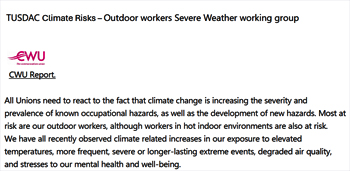 In 2025 he put together a report into the work being done with regard to climate change and outdoor working. Entitled TUSDAC - Outdoor Workers Severe Weather Working Group. (Download from the E-Library by clicking the image to the left)
The Trades Union Congress's (TUC
) Trade Union Sustainable Development Advisory Committee (TUSDAC) is a specialist working group of workplace temperature and environmental and climate change experts, advocating for legal maximum thermal limits, supporting extreme heat campaigns, and helping union representatives negotiate safer working conditions.
Ian Wilde from Unite and USDAW, whose work is featured below, commented on Jamie's documents regarding medication and hot working temperatures, saying:
"Your medication guidance is particularly useful because it demonstrates that vulnerability cannot be determined by age alone. Someone within the ordinarily recognised working-age range may be particularly vulnerable because of medication or an underlying condition. Future development should therefore consider medication-related vulnerability to both heat and cold, subject to appropriate clinical input. I would keep the effect on the worker’s bodily response separate from the different issue of storing medicines or devices at unsuitable temperatures."
 Involved as he is in working with other trade union extreme heat specialists, Jamie has this week, put his weight behind supporting the specialist work being done by Unite and USDAW member, Ian Wilde, in formulating a detailed framework and evidence gathering principles needed in order to bring to fruition, new legislation suitable to tackle climate change as it effects workplace temperatures, and specifically in creating maximum and minimum workplace temperature health & safety legislation.
Ian Wilde has been working on putting together suitable and appropriate frameworks to support the formation of workplace agreements and extending existing H&S Legislation to include the limitation of maximum and minimum workplace temperatures beyond which work can continue without mitigations or where this is not possible; the stopping of the work.
Ian has a wealth of experience in workplace health & safety and is a trade unionist, having worked in the UK, and New Zealand. He has developed two policy frameworks addressing cumulative occupational exposure from sustained shift work and workplace temperature.
All of his work has been undertaken in a personal capacity.
Drawing on that experience, he has developed two policy frameworks addressing cumulative occupational exposure from sustained shift work and workplace temperature. His work is driven by the belief that prevention and effective controls must come first. Where significant exposure remains, workers should receive fair compensation for bearing it, without compensation replacing the employer’s duty to prevent or reduce avoidable risk. Where past exposure was not properly controlled, recorded or addressed, there should be a consistent route to retrospective assessment and an appropriate remedy.
He told Unionsafety:
"My work is driven by the belief that prevention and effective controls must come first. Where significant exposure remains, workers should receive fair compensation for bearing it, without compensation replacing the employer’s duty to prevent or reduce avoidable risk. Where past exposure was not properly controlled, recorded or addressed, there should be a consistent route to retrospective assessment and an appropriate remedy."
He added by way of context to his work:
"The broader concern is that businesses may receive operational and financial benefits from shift working or avoid expenditure needed to manage occupational exposure to heat and cold. This applies both where workplace temperatures can be controlled directly and where outdoor exposure must instead be managed through working hours, workload, staffing, equipment and protective measures, including planned opportunities to warm up or cool down in suitable rest areas.
Where those risks and costs are not properly addressed, workers, their families and public services may be left bearing the resulting health, wellbeing and financial consequences."
Ian has contacted several unions, including his own union, Unite. Speaking about the responses he has had to his work, he said:
"The strongest sustained support and engagement I have received so far has come from Jamie at the CWU."
He has also been in correspondence with Ed Milliband, Secretary of State in the Starmer government, and with the Dept of Work and Pensions, urging their support
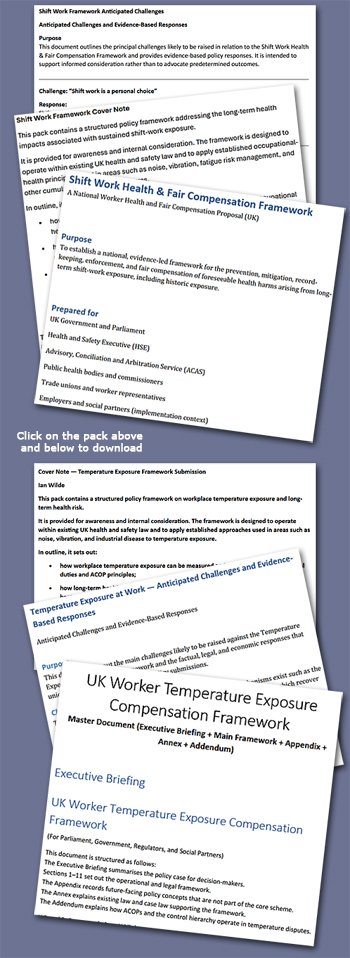
Ian has kindly provided unionsafety with the detail of his work and the documents which make up his two frameworks which are available to download.
The key points raised are:
- Foreseeability and existing knowledge: The breadth of evidence already available — from trade unions, academia, occupational health bodies and regulators, including collaborative work referencing a named professor and a vulnerability/WBGT (Wet Bulb Globe Temperature) matrix cited in a TUSDAC report — supports the view that occupational temperature risks are widely and publicly recognised.
- Scope of the employer's duty: Employers are expected to carry out suitable and sufficient risk assessments, obtain competent health and safety assistance where necessary, and introduce appropriate controls. This applies particularly to large employers with established health and safety resources, extensive workforces, and substantial operational, occupational-health, absence and incident data — such employers may not need to commission bespoke academic studies, but should be expected to carry out workplace-specific assessment, monitoring and review of how known hazards affect their workforce, with proportionate controls implemented where a material risk should have been identified.
- Purpose of the proposed frameworks: The frameworks aim to make the prevention, recording, review and fair compensation of temperature-related harm more consistent, and to provide structured models for assessing retrospectively whether risks were identified, controlled, recorded, reviewed and communicated — and whether recognition or compensation may now be warranted where they weren't.
- Role of government and regulators: For the Department for Work and Pensions and the Health and Safety Executive, the relevant question is whether guidance, recording requirements and enforcement have kept pace with recognised risks. Where foreseeable exposure wasn't properly assessed, controlled, recorded or communicated, and workers absorbed the consequences, that strengthens the case for recognition and compensation.
- Vulnerability beyond age: Vulnerability to heat cannot be determined by age alone — medication or an underlying condition can heighten risk for people within the ordinarily recognised working-age range. Future guidance should account for this, with appropriate clinical input, while keeping the effect on a worker's body distinct from the separate issue of safely storing medicines or medical devices in hot conditions.
- Heat and shift work: Rising temperatures interact with recovery from shift work — early-shift workers may need to sleep while their homes are still hot, and night workers (including postal sorting staff) may have to sleep through the hottest part of the day. Employers can't control the weather or a worker's home environment, but they do control shift length, overtime, consecutive shifts, recovery intervals, workload, breaks, workplace temperature and fatigue precautions — and foreseeable heat should inform fatigue-risk management even where the resulting sleep loss occurs away from the workplace.
- Sequencing of reform: Given the risk that frameworks remain under continuous development without ever being implemented, the preference is to establish the current frameworks as a working baseline and policy precedent now, then expand them through scheduled review — adding medication-related vulnerability, heat-related recovery, cold effects and UV exposure — without delaying the core prevention, recording and compensation principles. Historic exposure that was already reasonably foreseeable shouldn't be excluded from recognition simply because a relevant framework module is adopted later.
- Independent evidence-gathering: Trained union health and safety representatives should be involved in checking that workplace temperature or thermal-condition measurements are being properly taken, recorded and retained, and — where suitable arrangements and equipment allow — should be able to take and document independent check readings during inspections. This would provide objective evidence alongside workers' own accounts, reducing reliance on records created and controlled solely by the employer. The correspondence also stresses that contemporaneous measurements and worker accounts, gathered at the time of exposure, are more reliable than evidence reconstructed retrospectively — underscoring why independent, consistent, durable record-keeping is treated as central to the frameworks' aims.
- Cross-union coordination: The correspondence describes an ongoing effort to coordinate work on these frameworks across more than one union, including sharing evidence such as the WBGT vulnerability matrix and academic input to support a shared case for reform. Part of this involved a proposal for a worker survey intended to test, empirically, whether the risks and recording gaps identified in the frameworks exist in practice — and a related suggestion that trained union health and safety representatives be involved in independently checking and documenting workplace temperature readings, to supplement records held by employers.
- Stalled progress: According to the correspondence, this survey proposal did not receive support from one of the unions involved, and no alternative survey or representative-led evidence-gathering process has yet been confirmed in its place. The author raised the matter at an earlier meeting and again when proposing the survey, but describes not having received a substantive update on what consideration, if any, has been given to it since. Because a cautious approach was recommended regarding employment and conduct risk, no clear union-supported route for gathering this evidence has yet been established.
- Consequences of delay: The correspondence notes that this has meant missed opportunities to gather real-time worker evidence and workplace temperature measurements during recent hot weather. It suggests some evidence could still be collected retrospectively, but that contemporaneous data — recorded at the time of exposure — is likely to be more reliable than anything reconstructed later, which the author frames as a significant gap given that reliable, independently-verified evidence is central to what the proposed frameworks are trying to achieve.
- Next steps: The author indicates they intend to consider a further response before forming a final view on how this specific strand of coordination has been handled, and will share any substantive update once received.
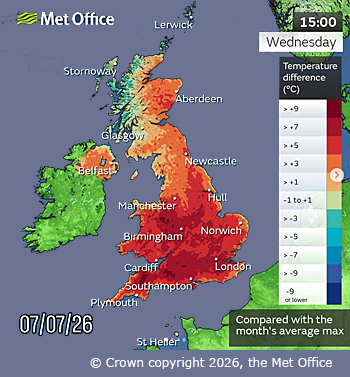
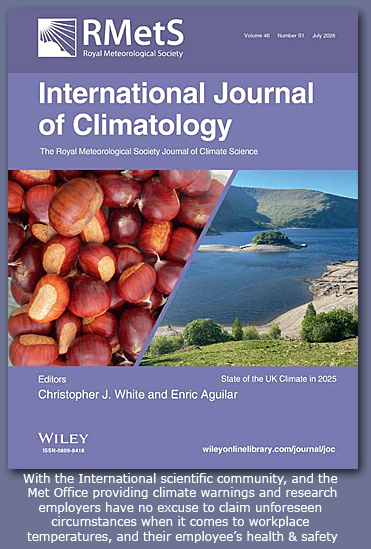
Further documentation and research which supports the need for Ian Wilde's work and that of trade union officials like Jamie McGovern, are easily found and understood. The latest of which referred to by UK's Met Office can be downloaded from the E-Library or by clicking on the image below.
 Excessive heat and cold in workplaces such as BT/Openreach telephone exchanges, call centres, Royal Mail Distribution Centres, outdoor working by postal workers and telecom engineers including pole climbers and cable layers; has been a major problem since the 1970s, and not just the last ten years.
However, employer's and Government agencies have been more focused than ever on working conditions, partly due to the lack of increasing productivity in the UK, the levels of sick leave amongst workers and climate change which inevitably is causing huge spikes in temperatures during which people are expected to work as normal.
The effect of heat on workplaces, creating an exhausted, heat-stricken workforce, effectively minimising their output, is now something which is reflected in higher numbers of deaths amongst workers suffering from respiratory and pulmonary illnesses, increased sickness levels; despite warnings from Trade Unions consistently about the impact of workplace temperatures, and not just for outdoor workers.
The risk to pregnant workers being exposed to hot offices and outdoor heat is especially acute, and risks the health of both mother and baby.
The inaction from employers to mitigate dangerous temperature levels in their workplaces and the Government refusal to act over workplace temperature legislation has been almost criminal.
The CWU has been at the forefront within the TUC arguing for legislation to protect workers and enforce responsibility upon employers for the duty of care to ensure worker's health is not detrimentally impacted during spells of excessive hot and cold weather; be they working indoors or outside. This has been the case since the early '70s and substantially since the Thatcher years of the '80s during which workers' rights along with their health and safety were attacked by repeated Tory Government dictate. Sadly, Labour Governments until this year, did nothing about it.
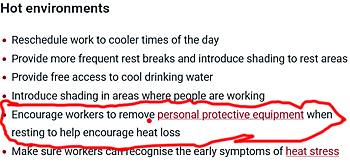
Furthermore, enforcing authority, the HSE, clearly supports not making changes to legislation, instead provides guidance for working in hot weather, that frankly, is beyond belief in that it suggests workers swap one workplace health & safety risk for another, by removing PPE in high temperature environments, when resting. In doing so, they actually increase the risk of injury, illness, and accidents as a result of their argument favouring removing personal protective equipment in hot weather! Even doing so in hot weather will increase exposure to heat, unless the worker is able to rest in a cool environment. But the danger is that the PPE is not then worn again following any break.
This is especially true of small businesses where often PPE is not adequately provided, e.g. stone cutting, paving stone laying, and working at heights. It is rare to see goggles and fall arrest systems being used by workers from small building companies. On the contrary, builders and roof top workers are often working in the heat without shirts and any form of covering, increasing UV exposure and the risk of heat exhaustion which can in fact kill.
In the final analyses of the situation, PPE should in fact address also the need to wear it in either hot or cold temperatures, and include protection from heat, UV Rays, and be as less cumbersome as possible.
 PPE may include such things as specialised climbing spurs, a work positioning body belt or harness, and an adjustable pole strap.
Workers must also wear high-top pole-climber boots, a certified industrial hard hat (often with a chin strap), protective eyewear, heavy-duty gloves, and durable, long-sleeved clothing, as well as Fall Arrest Lanyards. For working in hot confined spaces, a full-body harness and tripod winch system
for retrieval, a respirator or breathing apparatus, a safety helmet, and durable, chemical-resistant coveralls.
Working in environments which require stone cutting and operations that create plumage of particles and gases, PPE such as wraparound safety glasses or goggles to prevent dust, debris, or splashes from entering the eyes, and respirators to ensure non-inhalation of dust and very small particular matter.
Source: Ian Wilde / Jamie McGovern, CWU / Met Office / HSE /unionsafety
See also:
Green MP Will Introduce Bill On Maximum Workplace Temperatures
Workplace Temperatures And Inadequate Legislation Is A Risk To Life!
